El laberinto
del fauno
Are you a Guillermo del Toro fan? The stone maze did not exist before filming: it was built from scratch in a meadow in Segovia, and the moss on the trees was painted sawdust.
Pan's Labyrinth Filming Locations in Spain
The mill where Ofelia arrives with her mother did not exist before filming. Guillermo del Toro had it built in a meadow of the Sierra de Guadarrama as a full 360-degree structure with four complete walls, not a partial set. The stone maze beside it was not an ancient ruin either: it was built during those same weeks in the summer of 2005.
The filming locations of Pan's Labyrinth combine purpose-built sets with real places carrying enough history to make everything feel true. Exteriors were shot in the Segovia mountains and the ruins of Belchite; interiors were built in studios in San Sebastián de los Reyes, where Del Toro personally supervised all 34 sets designed by Eugenio Caballero. This guide covers the four main locations, two travel routes, and what you can see at each site today.
Filming Locations of Pan's Labyrinth
Four locations across three provinces: from the Segovia meadow where Del Toro built his world to Civil War ruins that needed no production design to look devastated.
When I arrived at Prado de Juan Llanos early in the morning, with mist hanging between the pines and damp ground underfoot, I immediately understood why Del Toro chose this clearing. Valle del Arroyo Mayor has that out-of-time feeling, somewhere between a Central European forest and a Castilian moor. The mill and maze are gone, dismantled after filming, but the meadow remains almost unchanged: open, slightly unsettling, and ringed by pines filtering the light.
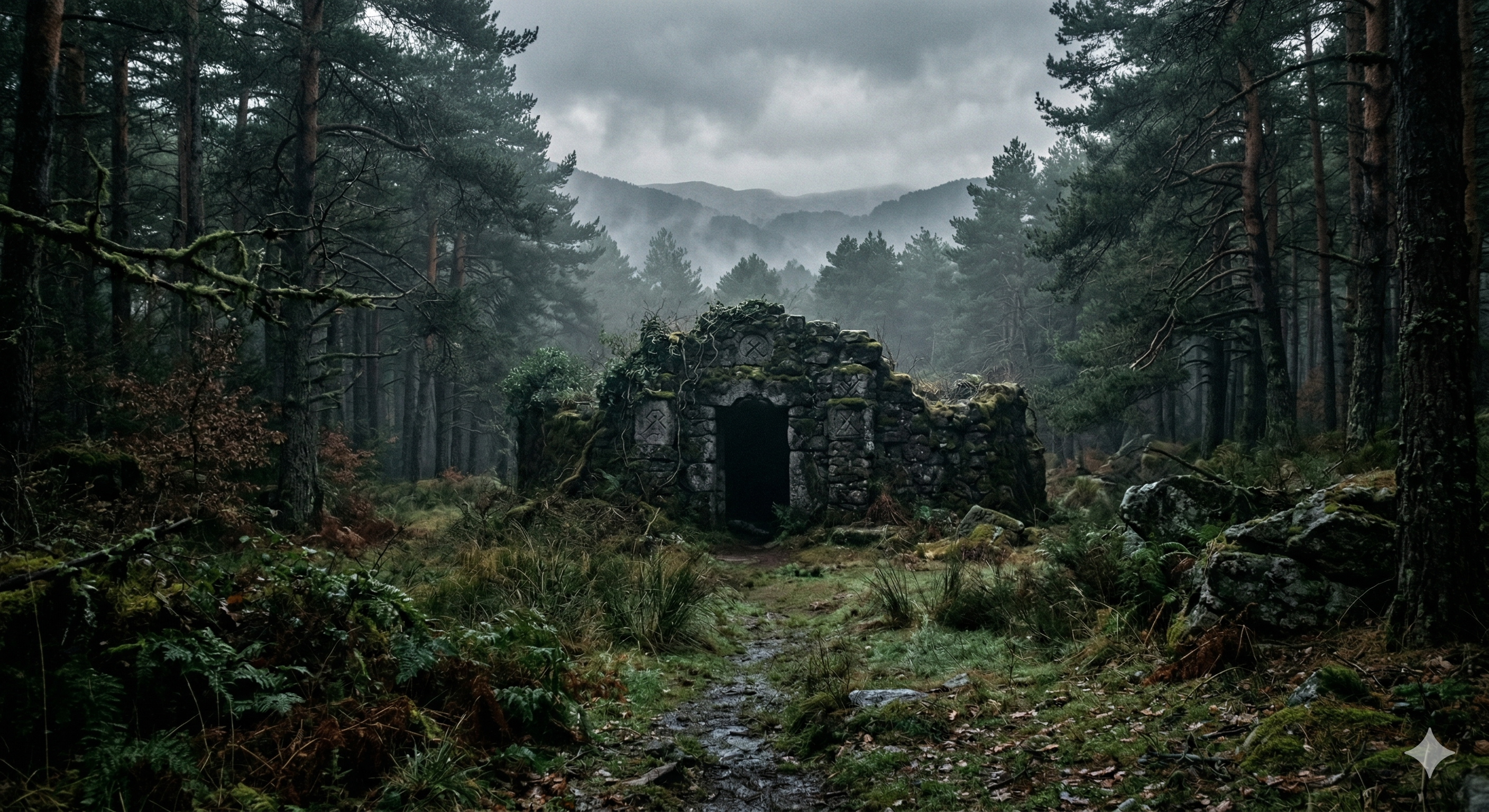
The crew built the mill as a real structure with four complete facades. That summer brought drought, natural moss had disappeared, and the art department covered trees with green-painted sawdust. On screen, it is almost impossible to notice.
Instagram: Low-angle shot through the pines, with trunks framing the sky, echoing Del Toro's shots looking up from the maze pit.
📍 View location on map
Belchite needed no production work to look like a war-torn town, because it is one. The 1937 bombing left ruins largely as they stand today: frozen in time, unrestored, an involuntary monument. Guillermo del Toro chose the Church of San Agustín for some of the film's harshest scenes. Standing in that roofless nave under the open sky, there is little left to imagine.
Del Toro used the Church of San Agustín for the opening and closing images. Entry is only possible by guided tour, and guides usually explain both the films shot here and the bombing history with striking detail.
Instagram: Low-angle shot of the half-ruined tower against the sky; look for black stone against orange sunset light.
📍 View location on map
Talamanca de Jarama is one of those towns cinema discovered before mainstream tourism. Its medieval walls and well-preserved monastery complex have an old-stone texture that is impossible to fake. For supporting real-world scenes set in 1944 Spain, Del Toro found what he needed here with minimal art-department intervention. The town remains largely unchanged and far from mass tourism.
This town is a recurring location for Spanish period and fantasy productions. Its Romanesque and Mudejar arches offer strong visual consistency on camera without heavy transformation.
Instagram: Romanesque or Mudejar arch in foreground with Castilian sky behind; ochre stone contrasts well at any hour.
📍 View location on map
The San Sebastián de los Reyes studios are the creative heart of the film. Here, Eugenio Caballero, who won the Oscar for Art Direction for this work, built the 34 interior sets that bring the fantasy world to life. Del Toro supervised details personally, from maze wall textures to the Pale Man banquet table. The studios are not open to visitors, though the exterior can be seen from the street.
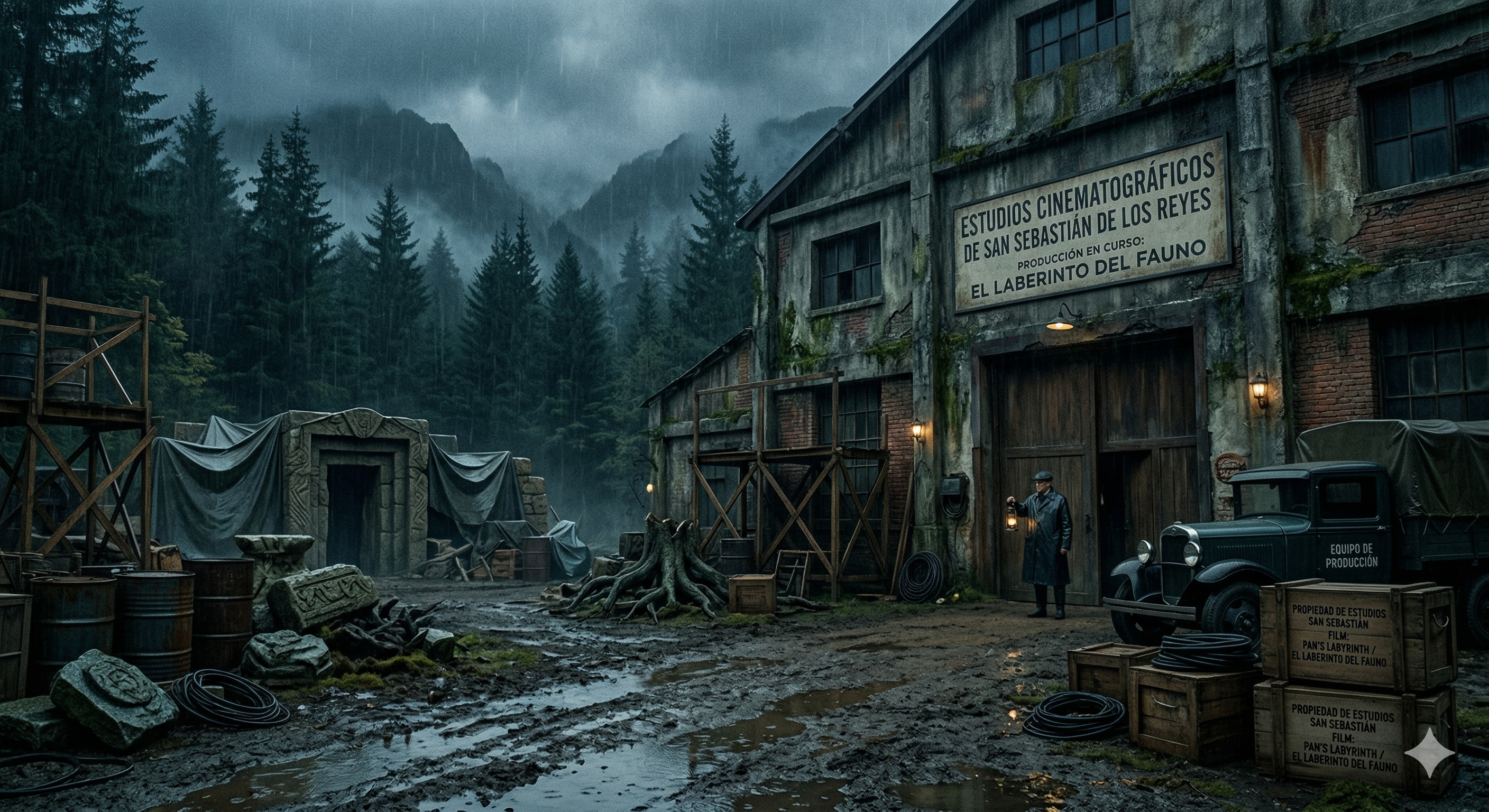
The Pale Man scene, the eyeless figure with eyes in his palms, was designed with direct reference to Goya's painting "Saturn Devouring His Son." Doug Jones, inside the suit, spent around five hours a day in makeup throughout the shoot.
Note: There is no official set tour. The official making-of, available on streaming platforms, shows the construction of each set in detail.
📍 View location on map
Map of Pan's Labyrinth Locations — Routes
Two routes to visit Pan's Labyrinth locations: the Sierra de Guadarrama as a hiking day, and the Belchite ruins as a guided visit.