The Film
The Barcelona That Woody Allen Chose
The first time Cristina arrives in Barcelona in the film, the city is not a backdrop: it is a character. Woody Allen shot Vicky Cristina Barcelona in 2008 knowing exactly what he wanted to show — not the Barcelona of guidebooks, but the Barcelona that seduces.
Park Güell as the setting for an encounter that changes everything. Els Quatre Gats as the restaurant where a stranger with remarkable audacity decides to alter the course of two lives. Bar Marsella, founded in 1820, as the place where the absinthe does its work.
The locations where Vicky Cristina Barcelona was filmed are not sets built for the film. They are real places that have stood for centuries. This guide covers ten of them, with two routes, up-to-date prices and the exact angle for every photograph.
Locations
Barcelona — 7 film locations
Before anything begins, there is the mural. When Vicky and Cristina step off the plane, the camera does not frame the arrivals hall: it frames the Joan Miró ceramic mosaic that covers the entire wall of Terminal B. It is the first real image of the city, and it is deliberate. Allen wanted the arrival in Barcelona to be visually unlike any other airport in the world.
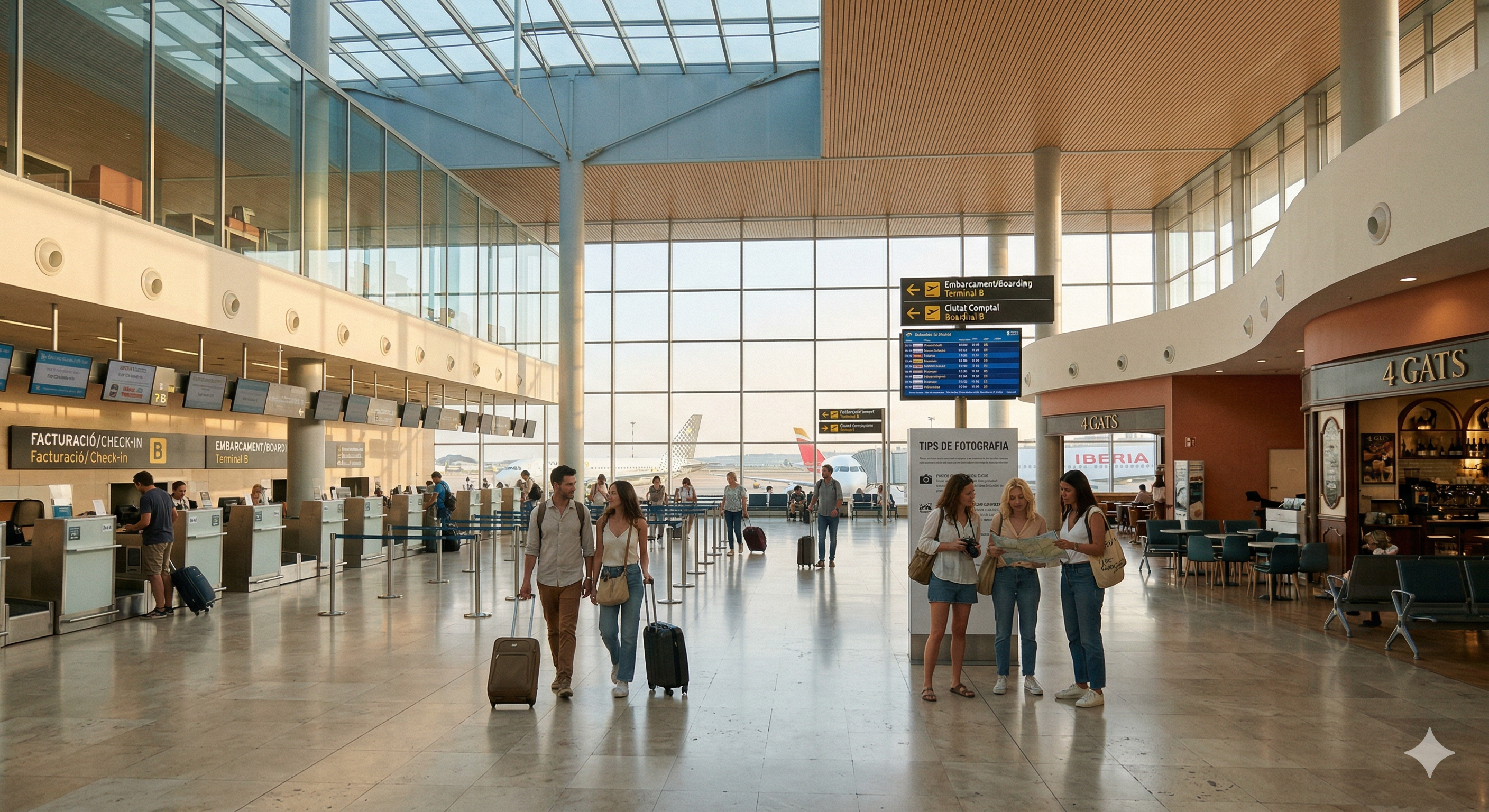
The arrival scene captures the famous Joan Miró ceramic mural, which has become the symbol of the airport. It covers 900 square metres and was installed in 1970.
Instagram: Wide shot capturing the full extent of the mosaic with travellers in motion behind.
📍 View location on map
Vicky and Cristina do here what everyone does: they arrive, look up, and fall silent. On screen, the Sagrada Família needs no music, no dialogue — the architecture does the work alone. Allen shot the sequence without a voiceover, just the two protagonists processing something too vast for words.
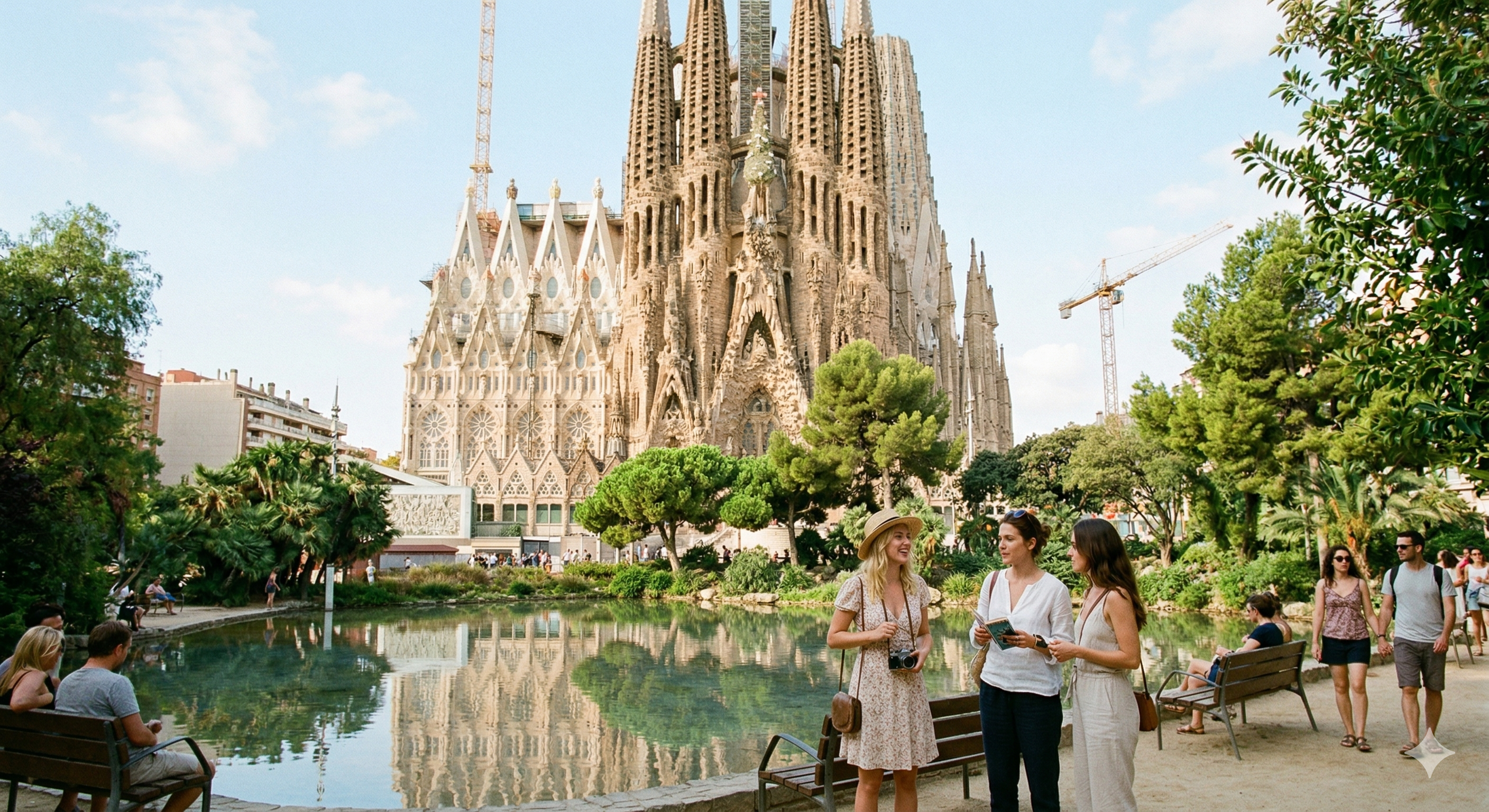
The temple has been under construction since 1882 and is the most recognisable symbol of the city in the film. Mid-morning light streams through the stained-glass windows of the central nave, transforming the interior into something that seems impossible.
Instagram: Low-angle shot of the Nativity towers from the edge of the reflecting pool.
📍 View location on map
This is where one of the film's most important turning points occurs. Vicky is studying Gaudí's architecture for her thesis when Juan Antonio appears, and the conversation by the salamander fountain — the very fountain that everyone photographs without knowing it staged the beginning of everything — is the moment the film stops being about tourism and becomes something else entirely.
To film that dialogue, the production team temporarily reduced the water pressure in the fountain so the sound would not interfere with the actors' voices. The dragon fountain was there — but silent.
Instagram: From the main terrace with views of the city and the gingerbread houses in the foreground.
📍 View location on map
The rooftop of La Pedrera is one of the most photographed spots in Barcelona, but there is something the film shows that tourists habitually miss: staying long enough for the sun to shift and the chimneys — those stone warriors Gaudí called "witch scarers" — to begin casting long shadows across the white floor. Allen frames those shadows in the film. They are the most poetic image in the picture.
This same rooftop was used previously by Michelangelo Antonioni in 1975 for The Passenger with Jack Nicholson — Woody Allen was not the first to discover its cinematic potential.
Instagram: Through one of the chimney arches with the Sagrada Família visible in the background.
📍 View location on map
This is the scene that defines the film. A man they do not know at all sits down at their table and directly proposes a trip. Juan Antonio pulls it off because the setting works in his favour: Els Quatre Gats carries the authority of places that have stood a very long time. It opened in 1897. On its walls hang reproductions of the posters Picasso designed for this very establishment when he exhibited here for the first time.
The restaurant opened in 1897 and was the venue for Pablo Picasso's first solo exhibition. Juan Antonio's seemingly absurd proposal sounded less absurd surrounded by all of that.
Instagram: Entrance door with modernist ironwork in the frame. The bar counter is freely accessible without a reservation.
📍 View location on map
There are bars that exist solely to appear old. Bar Marsella does not need to appear anything: it is the oldest bar in Barcelona, open since 1820, and everything inside it — the dust-covered bottles, the bevelled mirror behind the bar, the engravings in the wood — has sat untouched for decades. When Cristina and Juan Antonio order absinthe here, the camera does nothing special. It doesn't need to.
Founded in 1820, Bar Marsella is the oldest bar in Barcelona. Hemingway, Dalí and Picasso drank at this very bar. The film added Scarlett Johansson to that list.
Instagram: Close-up of the absinthe glass with the sugar cube before lighting it.
📍 View location on map
Going up to Tibidabo in the film is not a tourist excursion: it is a way of looking at Barcelona from outside, of seeing the city as a map one has yet to learn. Allen uses the park's views to convey the scale of what Vicky and Cristina are living through. The red plane of the L'Avió ride, suspended over the void with the Mediterranean behind it, is perhaps the most recognisable shot in the film.
Tibidabo is Spain's oldest amusement park, in operation since 1901 — over 120 years carrying Barcelonans and visitors to the top of the city.
Instagram: Panorama of the city with the Sagrat Cor temple in the background during the last hour of light.
📍 View location on map
Localizaciones
Asturias — Oviedo & Avilés
The trip to Oviedo is the film's turning point. The hotel is not a generic hotel: it is La Reconquista, an 18th-century palace built as a charitable hospice and converted into one of the most important historic hotels in northern Spain. It is the venue of the Princess of Asturias Awards. The inner courtyard — those stone galleries with columns — is the space Allen uses for the film's most uncomfortable conversations.
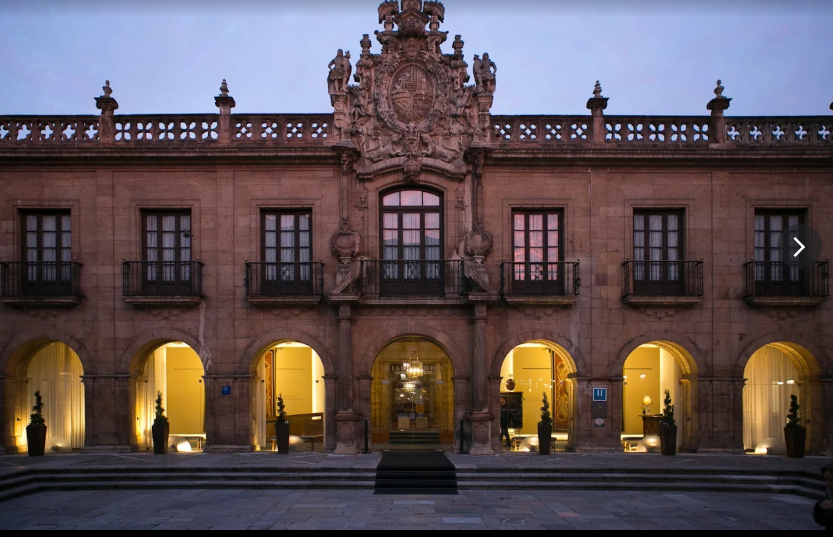
The hotel is housed in an 18th-century former hospice and is the venue for the Princess of Asturias Awards ceremony. Heads of state have stayed here, and in the midst of all that, Vicky, Cristina and Juan Antonio attempt to resolve something that none of the three knows how to resolve.
Instagram: Symmetrical shot of the façade with the heraldic coat of arms centred.
📍 View location on map
Juan Antonio takes Vicky and Cristina to see something that most tourists passing through Oviedo never reach: the largest pre-Romanesque church in Spain, built in the 9th century by order of Alfonso II. Its interior frescoes have no equivalent in the Europe of their era — nothing comparable from that period exists in Italy or France. Allen lets Juan Antonio explain it, and in that explanation reveals more about the character than any other scene.
The church was built in the 9th century and is notable for its unique frescoes, unparalleled in the Europe of the time. It is a UNESCO World Heritage Site together with the rest of Asturian pre-Romanesque art.
Instagram: Wide shot of the building with the green Asturian mountains behind.
📍 View location on map
The San Juan lighthouse is the final location of the Asturian trip, and the most open of all: just cliff, just wind, just sea. Allen uses this space for conversations that require that scale, ones that cannot fit inside a hotel or a restaurant. What the characters say here before the Cantabrian Sea is neither final nor conclusive — this is Woody Allen, there are no conclusions — but the conversation is real, and the lighthouse makes it feel as though the landscape has waited centuries for someone to have it.
In the film, Avilés is presented as a picturesque coastal corner that complements the romantic atmosphere of the Asturian journey. The location reinforces the contrast between the urban intimacy of Oviedo and the open scale of the Cantabrian coast.
Instagram: Lighthouse silhouette against the Cantabrian Sea with an orange-to-blue gradient sky.
📍 View location on map
Routes
How to Follow the Film's Footsteps
Barcelona in a day, following the film. The route starts at the Sagrada Família with the morning light, moves to the rooftop of La Pedrera at midday, continues to Park Güell at golden hour and ends at Els Quatre Gats and Bar Marsella as night falls. It is the film's logical sequence and also the most comfortable way to do it by public transport.
- Basílica de la Sagrada Família
- La Pedrera / Casa Milà
- Park Güell
- Restaurante Els Quatre Gats
- Bar Marsella
Oviedo as your base: Hotel La Reconquista in the morning, the pre-Romanesque church after midday, and the lighthouse at Avilés at sunset. The transition from Oviedo's historic centre to the Cantabrian coast is part of the appeal: two completely different landscapes just 25 kilometres apart.
- Hotel Eurostars de la Reconquista (Oviedo)
- Iglesia de San Julián de los Prados (Oviedo)
- Faro de San Juan (Avilés)
Practical Tips
Before You Go: What You Need to Know
Frequently Asked Questions
Everything You Need to Know Before You Go
At ten real locations in Spain: seven in Barcelona (El Prat Airport, Sagrada Família, Park Güell, La Pedrera, Els Quatre Gats, Bar Marsella, Tibidabo) and three in Asturias (Hotel La Reconquista in Oviedo, the Church of San Julián de los Prados and the San Juan lighthouse in Avilés). No exterior scenes were shot in a studio.
Yes. Els Quatre Gats, where Juan Antonio first sits with Vicky and Cristina, is still open in Barcelona's Gothic Quarter. It is an active restaurant serving Catalan cuisine, open since 1897. You can dine in the same room where the scene was filmed.
In the Raval neighbourhood, Carrer de Sant Pau 65. Founded in 1820, it is the oldest bar in Barcelona. It remains a genuine local bar: not a museum, not a themed bar. The absinthe they serve is the same as in the film.
For the Barcelona locations, a full day (the Gaudí and Bohemian route). For Asturias, another full day by car from Oviedo. If you combine both destinations in one trip, you need a minimum of three or four days.
Yes. Penélope Cruz won the Academy Award for Best Supporting Actress for her role as María Elena, Juan Antonio's ex-wife. It was her first Oscar and the first won by a Spanish actress for a role performed in Spanish within an English-language film.
Share